
Around one in five businesses does not make it past year one. By year five, nearly half are gone.
But most of them don’t collapse overnight. They drift into trouble gradually: margins get thinner, invoices take longer to collect, sales depend on fewer customers, and every month starts to feel like a bet that the next one will be better.
By the time the problem becomes obvious, the owner is usually already tired, and cash is tight. That is when working harder stops being a strategy. A struggling business needs a clear read on what is broken and disciplined action before the runway disappears.
This guide gives you a practical recovery framework for that moment. You will learn how to diagnose the real issue, cut costs without damaging the engine of the business, stabilize cash flow, and rebuild revenue once the bleeding is under control.
It is written for owners who know something has to change and want a concrete way to start.
How to tell if your business is in real trouble
Plenty of businesses go through rough quarters. A struggling business is different. It's the one where the rough quarter has stretched into three, and the owner is starting to fund operations from savings or credit lines.
Cash flow turns negative for three consecutive months
A single bad month happens to everyone, but three in a row is a pattern. By the third negative month, the business has typically eaten through its operating cushion and started borrowing to cover payroll and core operating costs. That's the signal that the problem isn't seasonal.
Customer churn outpaces new customer acquisition
This is the leading indicator, especially for a subscription or service business. When monthly cancellations exceed new sign-ups for two quarters running, revenue is going to fall. No amount of cost-cutting fixes a leaky bucket; the acquisition and retention math has to come back into balance.
The owner is the only person who can do critical work
When the business can't run for a week with the owner away, two things are true. The owner is exhausted, and the business has no transferable value. Recovery requires fixing both, often by documenting the work the owner does and training someone else to do parts of it.
Vendor payments are slipping behind
Late payments to suppliers are an early warning that the company knows about before its customers do. By the time vendors are calling, the business has been juggling cash for a while. This is often the first concrete sign that recovery has to start now instead of next quarter.
If two or more of these apply, the business isn't going through a rough patch – it’s in the early stages of failure, and the framework below applies.
Diagnose the actual problem, not the symptom
The most common mistake owners make is treating symptoms.
Revenue is down, so they push the sales team harder. Or, margins are thin, so they cut staff. These responses sometimes help, but they usually paper over the real issue and buy a few months at the cost of making the underlying problem harder to fix later.
The actual diagnosis starts with a different question:
Where is value leaving the business faster than it's coming in?
Map where the money goes
Pull the last 12 months of financials and group every expense into four categories:
- Direct cost of delivering the product or service
- Customer acquisition cost
- Fixed operating costs (rent, software, insurance, core staff)
- Owner compensation and discretionary spend
This map almost always reveals something the owner didn't expect. Maybe customer acquisition cost has crept up 40% over two years while pricing stayed flat. Software subscriptions could have multiplied, and nobody audits them. Or, a single underperforming product line is absorbing disproportionate operating attention.
Lacking this map, every recovery decision is a guess. With it, the first three or four moves become obvious.
Calculate the true margin on each product or service line
Owners usually know their overall margin. Fewer know which specific products or services are dragging the average down. In a multi-product business, a single underperforming line can absorb most of the available operating attention while contributing the smallest share of profit.
The exercise is straightforward, but tedious.
Allocate not just direct costs to each line, but a fair share of fixed costs based on time spent or revenue share. The picture that emerges is usually uneven: two or three offerings carry the business, or some are silently breaking even or losing money once fully loaded.
Knowing this changes the recovery conversation. The losing lines either get repriced or retired, while the winners get more attention. Owner time stops being divided equally across products and starts being concentrated where the return is highest.
Identify the most profitable and least profitable customers
Customer profitability tends to follow a heavy version of the 80/20 rule. 20% of customers generate 80% of profit, and a different 20% actively destroy profit through excessive service demands and slow payment.
Recovery starts with knowing which customers belong in which group:
- The profitable group needs more attention and protection.
- The unprofitable group either needs to be repriced or let go.
Owners are often afraid to do the second part, and that fear is often what got them into trouble.
Look at where time goes, not just where money goes
A business in trouble usually has a time problem as much as a money problem. The owner and key staff are spending hours on work that doesn't generate revenue or strengthen the business. Reactive admin and meetings that don't drive decisions eat hours every week and move nothing forward.
A simple time audit over two weeks, logging where every hour goes for the owner and any key staff, makes this visible. The audit almost always shows that 20 to 30% of total work hours go to activities the business could stop doing with no measurable harm.
Stop the bleeding before trying to grow
Recovery has a sequence. Trying to grow out of a problem before stabilizing the foundation is how businesses get into deeper trouble. The first 30 to 60 days of any turnaround are about stopping outflow instead of generating new revenue.
Cut what shouldn't be there
Software subscriptions are usually the easiest place to start. Established companies often run multiple active subscriptions, and audits routinely find that many of them are duplicative or completely forgotten. Cancel anything that hasn't been logged into in 90 days.
Vendor contracts come next. Almost all can be renegotiated when the company asks. Suppliers prefer a lower margin to a lost customer, especially in the current economy. A direct conversation about pricing or payment terms often produces savings on the largest line items.
Staffing is the hardest cut and the most consequential. Layoffs damage culture, institutional knowledge, and the company's ability to recover later. Before cutting heads, look hard at hours and roles. Some can be reduced to part-time, and some can be combined or moved to a contract. The full layoff is a last resort, not a first move.
Build a weekly cash discipline routine
The owner of a recovering business has to know the cash position with precision. Not the bank balance, which is misleading because it doesn't account for upcoming bills, but the rolling cash forecast.
A weekly 30-minute review covers what came in and what went out, and projects where the next gap will appear. The forecast horizon is 13 weeks because that's long enough to see a problem before it arrives, and short enough that the numbers are still meaningful.
In a healthy business, this is a finance function. In a recovery, it's an owner function.
Delegating the cash forecast at this stage is how owners lose visibility on the actual state of the business right when they need it most.
Renegotiate payment terms with customers and suppliers
A struggling business often has the wrong cash conversion cycle. Customers paying net-60 while suppliers demand net-30 is a recipe for chronic cash crunches, even when the business is technically profitable.
Renegotiate. Move suppliers to net-45 or net-60 where possible, and customers to net-15 or upfront payment where the relationship allows. New customers get the shorter terms by default. Old customers get an offer of a small discount for accelerated payment.
The cash position can improve dramatically within sixty days, with no change in revenue, just by aligning the in and out timing better.
Raise prices on what's underpriced
Struggling businesses are often underpriced on at least one product or service, and the owner hasn't raised prices in eighteen months or more because they're afraid of customer pushback.
The pushback is usually smaller than expected. A 10% price increase typically loses two to five percent of customers and increases revenue from the rest. The math almost always favors the increase, especially when applied to long-tenured customers who are paying old rates from when the business was smaller.
Start with new customers. Apply the new pricing on signup, then move existing customers to the new rates with three months' notice. This sequence reduces churn risk while still capturing the revenue lift.
Rebuild the customer relationship layer
Once costs are under control and cash flow has stabilized, the next phase is rebuilding the revenue engine. This often means going back to the customer base they already have and asking why some left, why others stayed, and what would make staying easier.
Customer relationships are where struggling businesses usually have the most upside. Existing customers cost a fraction of new ones to retain, and lost customers can often be won back. Lapsed prospects who never converted often had a real interest that the business failed to follow up on.
This is where a CRM earns its place in a recovery plan. Not as a sales-team tool, but as the system that holds every customer relationship in one structured place, with full history and follow-up status.

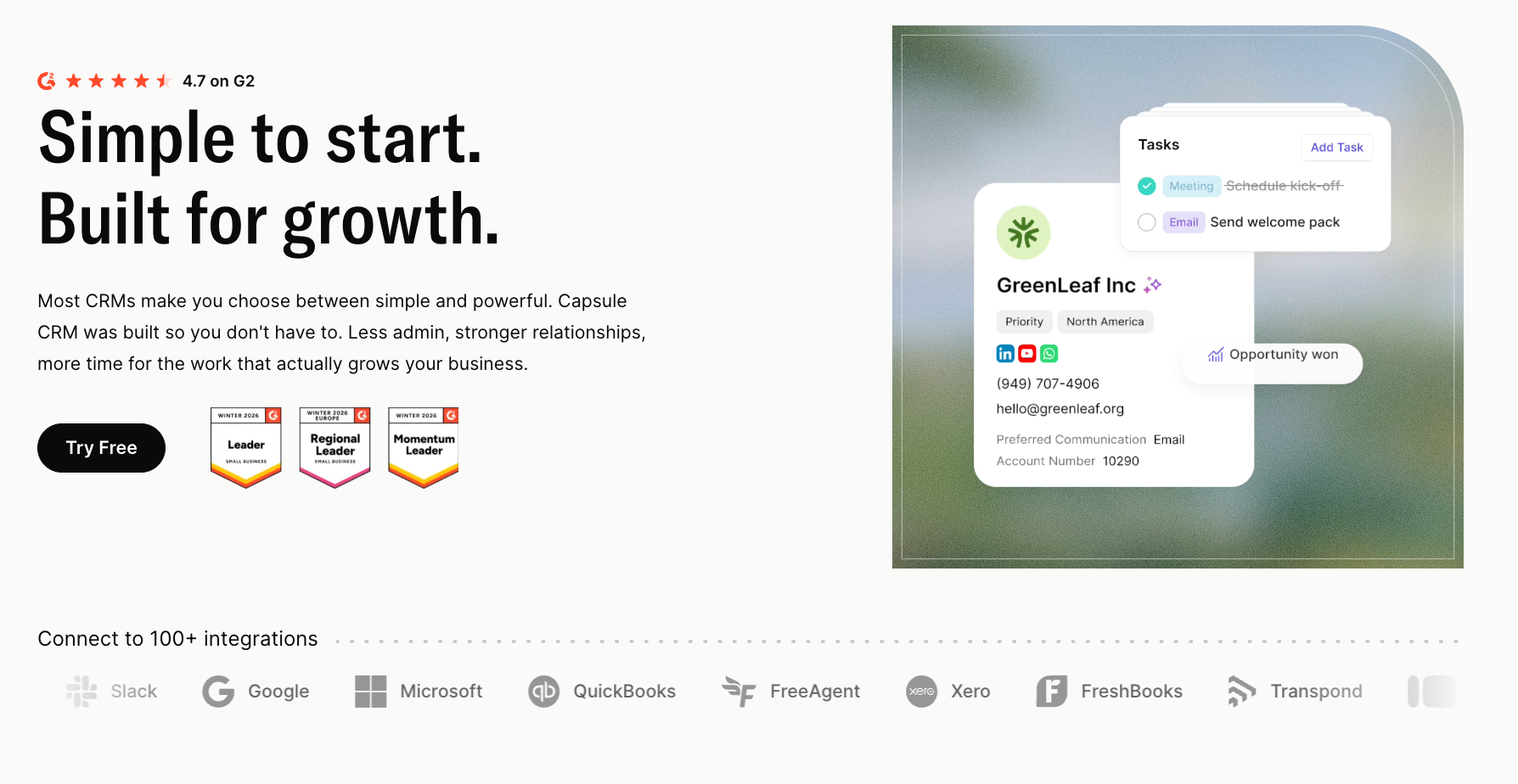
Capsule CRM handles this work specifically well for small and mid-sized businesses in recovery mode. The free plan covers two users and 250 contacts, which is enough for many owner-led recoveries to start with no extra monthly cost.
Three uses matter most during turnaround:
- Reviving dormant customers. Filtering contacts by last interaction date shows every customer who hasn't been contacted in six or twelve months. A struggling business usually has dozens of these. A focused outreach campaign to lapsed customers typically reactivates 10 to 15% of them, which produces revenue faster than any new acquisition channel.
- Closing leads that fell through. Old leads that never converted are often still gettable. A clean record of past inquiries, including who reached out and why they didn't move forward, gives the owner a targeted list to work through.
- Protecting the customers who stayed. The profitable customers from the diagnosis phase need to be actively retained. A tagged segment with scheduled check-ins, anniversary touches, and proactive problem-solving keeps the revenue base from eroding further.
The point isn't to replace whatever the business is already doing. The point is to make sure every relationship is visible to whoever is doing the recovery work, so the details stay covered even when the owner’s focus is elsewhere.
Rebuild revenue once the foundation is stable
After 30 to 60 days of cost discipline and customer retention work, the recovery shifts into the revenue rebuild phase. This is where many businesses get over-ambitious and start chasing new channels, new products, or new markets before the core engine is reliable.
Resist that impulse; revenue rebuilds in a specific order.
Maximize revenue from the existing customer base first
The cheapest revenue is from customers who already trust the business. Look hard at upsell and price-increase opportunities within the existing book before opening new acquisition channels. A profitable upsell campaign to existing customers often outperforms any new marketing initiative on dollar-for-dollar return.
Strengthen the highest-converting acquisition channel before adding new ones
Many businesses have a primary channel that works, like referrals or organic search, and a few smaller channels that aren’t pulling their weight. In recovery mode, double down on the primary. Add the marginal investment to whatever is already producing, not to whatever sounds exciting in industry news.
New channels can take even twelve months to learn and optimize. A business in recovery doesn't have that time.
Reintroduce growth investments slowly
Once revenue has stabilized at the new baseline for two or three months, the business can begin reinvesting in hiring and marketing spend. The order and pace depend on where the diagnosis points, but the principle is the same: prove the recovery is real before scaling back up.
What recovery looks like over twelve months
A realistic turnaround timeline runs about a year, not the ninety days that consultants like to promise. The phases break roughly into:
- Months one and two: stabilize. Cut what shouldn't be there and renegotiate vendor and customer terms. Stop the bleeding before anything else.
- Months three through five: rebuild relationships and retention. Reactivate dormant customers and protect the profitable ones already on the books.
- Months six through nine: rebuild acquisition. Double down on the channel that works and test pricing increases with new customers.
- Months ten through twelve: cautious reinvestment. Add back the resources that were cut, in priority order. Begin testing growth channels that were deprioritized during stabilization.
The businesses that follow this sequence usually emerge smaller but healthier, with better margins and stronger customer relationships than they had before the crisis. The businesses that try to skip phases tend to repeat the same crisis a year later.
The honest conversation no one wants to have
Some struggling businesses can't be saved.
The market shifted, or the financial hole is too deep to climb out of with the resources available. Owners who recognize this early and choose a planned wind-down or sale recover their own time and capital. Owners who don't usually lose both.
The recovery framework above works when the underlying business still has a viable customer base and an owner with the energy to do the work. When either of those is missing, the better answer is often an honest exit, not a longer fight.
The question to ask every quarter during recovery: Is the business getting healthier, or am I just keeping it alive with my own time and money?
If the answer to the first half is yes, keep going. If the answer is consistently no after twelve months of serious effort, the recovery framework isn't the right framework for the situation.
Start with what's broken, not with what's missing
The instinct in a struggling business is to add. New products and new channels. Bigger marketing budgets. Recovery almost always works the other way. Subtract what isn't producing, strengthen what is, and rebuild from a smaller, more disciplined foundation.
Tools like Capsule CRM act like a second set of eyes on the customer base. While the owner is fixing the bigger problems, the tool keeps the next call, next email, and next opportunity from disappearing into the noise.