Many architecture firms don't think of themselves as sales organizations, but business development is as central to a firm's survival as design quality. RFP responses, referral follow-ups, and long-dormant client relationships all require consistent management. However, that consistency is hard to maintain in a busy practice.
The numbers reflect this. According to research, firms that actively manage their business development pipeline win more repeat business than those that rely on word of mouth. A 2023 Deltek survey found that 62% of architecture and engineering firms identified business development as their top growth challenge. Most firms still track client relationships across disconnected email threads and spreadsheets: tools that were never designed for this purpose.
Here are the top CRM platforms designed to house your firm's data and drive your business forward in 2026.
Three key reasons architects benefit from a CRM
Bridging long lead cycles
Architectural commissions often involve large gaps between a feasibility study and a formal contract. A dedicated system prevents these dormant leads from falling into the "memory hole," keeping your firm top-of-mind when a client finally secures funding or planning permission a year later.
Protecting high-stakes revenue
In this industry, a single relationship can sustain a studio for several years. CRM tools remove the risk of losing these high-value opportunities due to poor follow-up so that "warm" prospects receive consistent attention through every stage of the design and tender process.
Centralizing the project-client record
Firms often struggle with data silos where project history lives in one folder and client communications live in another. Consolidating these records into one hub allows every team member to access the full context of a build, from the initial site visit to the final snag list.
The best CRM for architecture firms in 2025
1. Capsule CRM
Capsule is the strongest starting point for most architecture businesses. It's fast to set up, and the user-friendly interface means principals and staff actually adopt it – which is the prerequisite for any CRM delivering value.

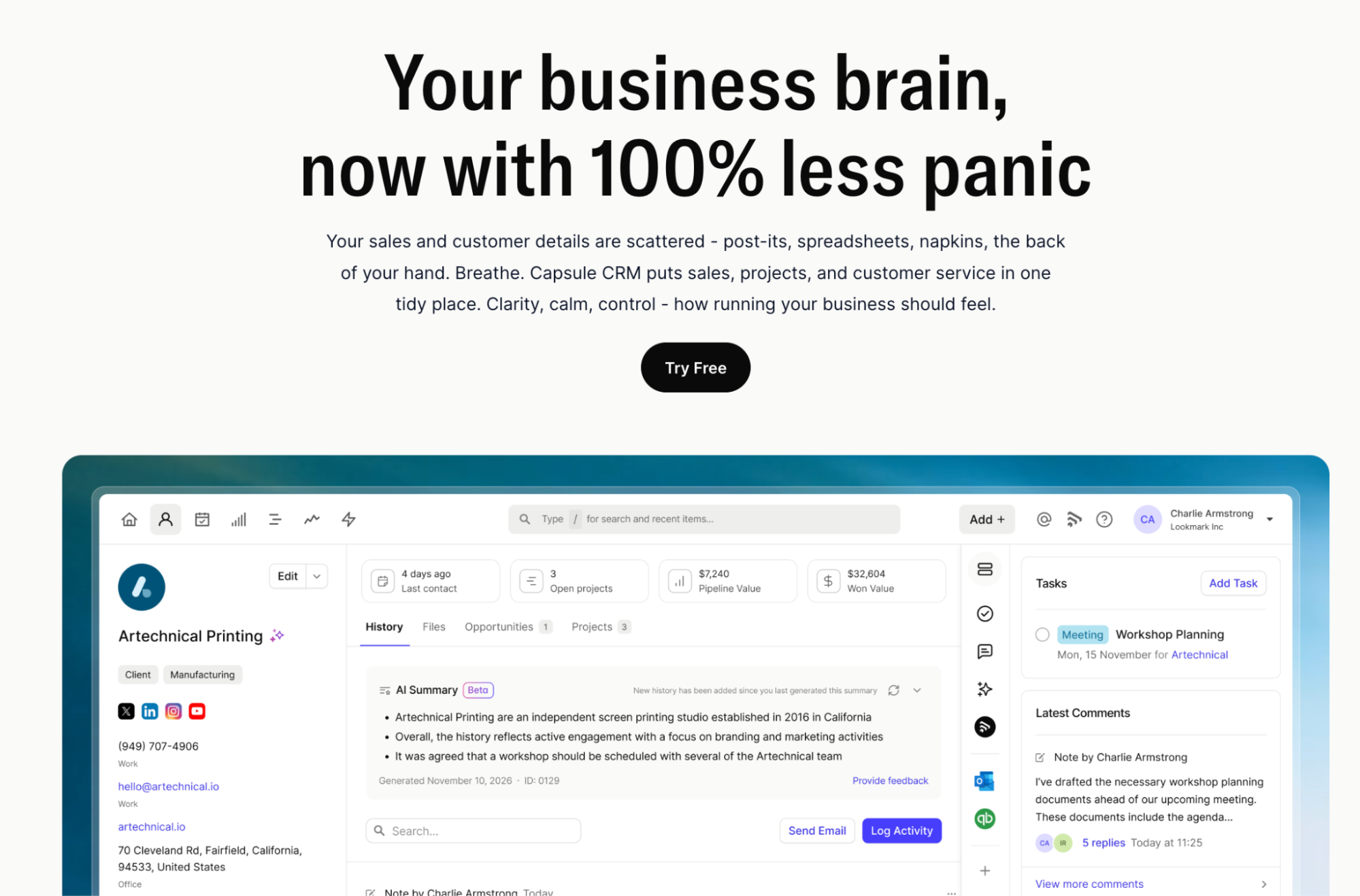
In architecture, the real work happens in the studio, but the business lives in the follow-up. Projects that span years often stall because client context gets buried in a partner's inbox or lost in a transition between team members. Capsule eliminates this administrative drag, acting as a studio's digital memory so principals can focus on the board.
Centralized project intelligence
Architecture isn't a high-volume transaction; it’s a long-term relationship. Capsule gathers every thread of a project – from early sketches to final contracts – into one clear dashboard. When a client calls about a site survey from eighteen months ago, any team member can pull up the full history instantly, so that your firm looks organized and attentive, even if the original project lead is out of the office.
AI built for studio realities
Capsule avoids flashy AI in favor of tools that reclaim billable hours. For an architect dealing with site visits and design deadlines, these AI tools function as a digital project lead:
- AI Summaries. Before a site meeting or a surprise client call, Capsule condenses years of project notes and activity into a concise brief. You walk into every conversation fully caught up without having to hunt through old threads.
- AI Pipeline Generator. You don't have to spend hours mapping out a sales process. Tell Capsule how your firm works, and it conjures a custom pipeline – tracking everything from the initial "back-of-the-napkin" inquiry to planning approval and final handover.
- AI Email Assist. Writing routine project updates or chasing unsigned fee proposals is a drain. This tool drafts those messages for you, maintaining a professional tone so you can get back to design work faster.
- AI Enrichment. Automatically keep client and consultant profiles updated with the latest background info.
Operational harmony
The platform manages the lifecycle. By integrating with Xero and QuickBooks, it connects design phases and the finance department.
Pricing: Free plan available. Starter from $18/user/month; AI features from $36/user/month.
Stop losing billable time to admin – try Capsule free for 14 days.
2. Scoro
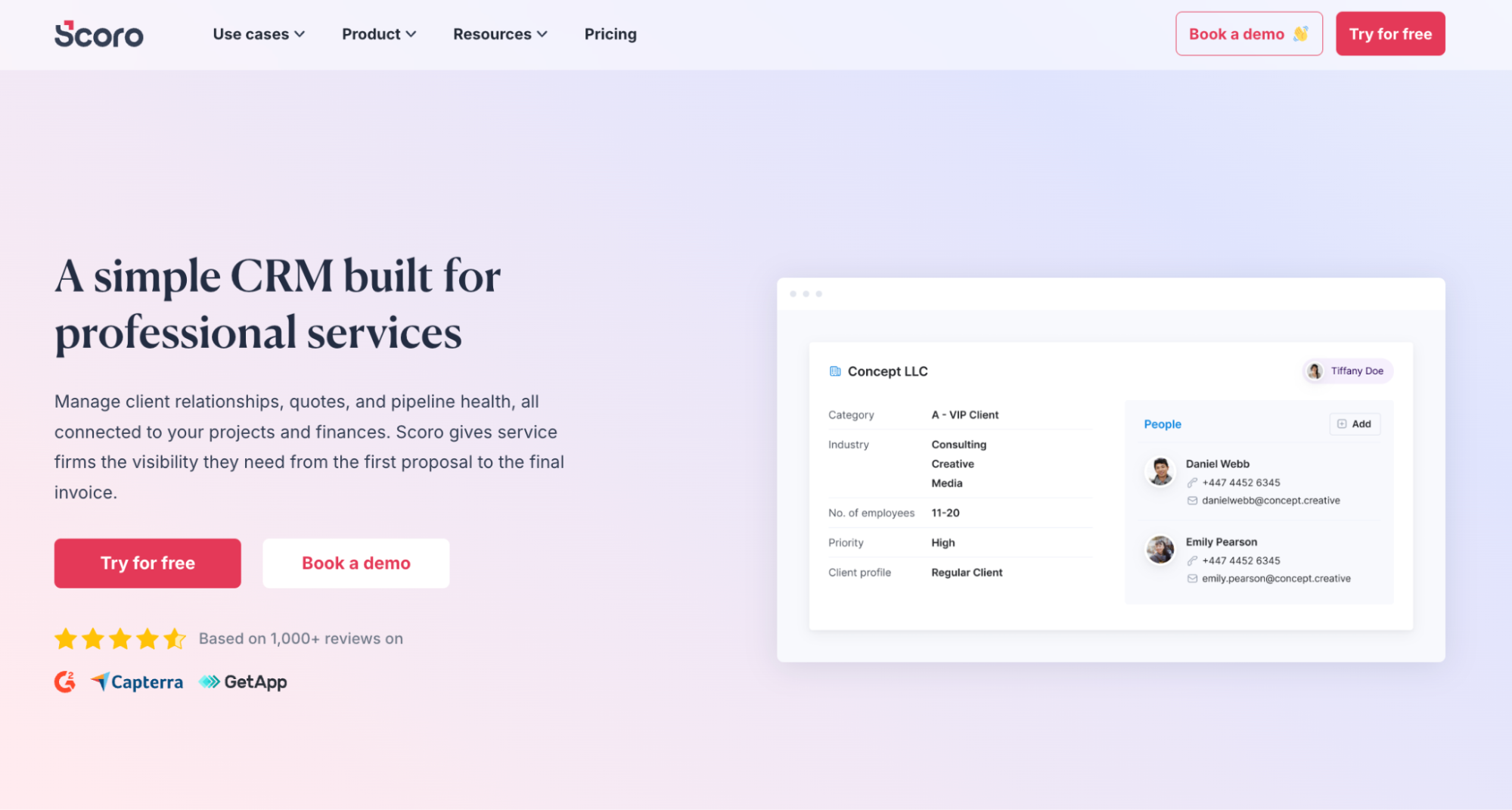
Scoro is less of a CRM and more of a firm-wide operating system. It targets the "fragmentation tax" that architects pay when they handle design files, project timelines, and fee tracking across four different apps. By consolidating project management with high-level business intelligence, it ensures that a principal's vision for a project stays aligned with the studio's financial reality.

The profitability dashboard
Scoro’s primary strength is the Live Project Pulse. It tethers every billable hour spent on a drawing set directly to the project's fee proposal. Instead of realizing a project went over budget three months after the fact, you can see in real-time when a "minor" design revision starts to erode the profit margin of a fixed-fee commission. Such level of transparency makes it easier to justify additional service fees when a client's brief begins to creep.
Resource & pipeline mapping
For studios managing a fluctuating staff, Scoro offers a birds-eye view of capacity. It allows you to map out which architects are over-leveraged on construction administration and who is available for a new feasibility study.
The trade-off: complexity vs. creativity
The depth of Scoro is its greatest asset, but also its primary hurdle:
- Unlike leaner tools, Scoro requires a significant design phase of its own. You have to be willing to spend weeks configuring the system to match your firm’s specific billing and project hierarchies.
- For a solo practitioner or a small boutique studio, the platform can feel like too much software. It rewards firms that have dedicated administrative support or a project manager specifically tasked with keeping the data clean.
If you’ve outgrown the "organized chaos" of spreadsheets, Scoro provides the structural integrity to scale. If your goal is simply to stay on top of client follow-ups with no heavy administrative burden, a more agile CRM remains the more practical choice.
Pricing: Essential from $26/user/month.
3. BQE Core
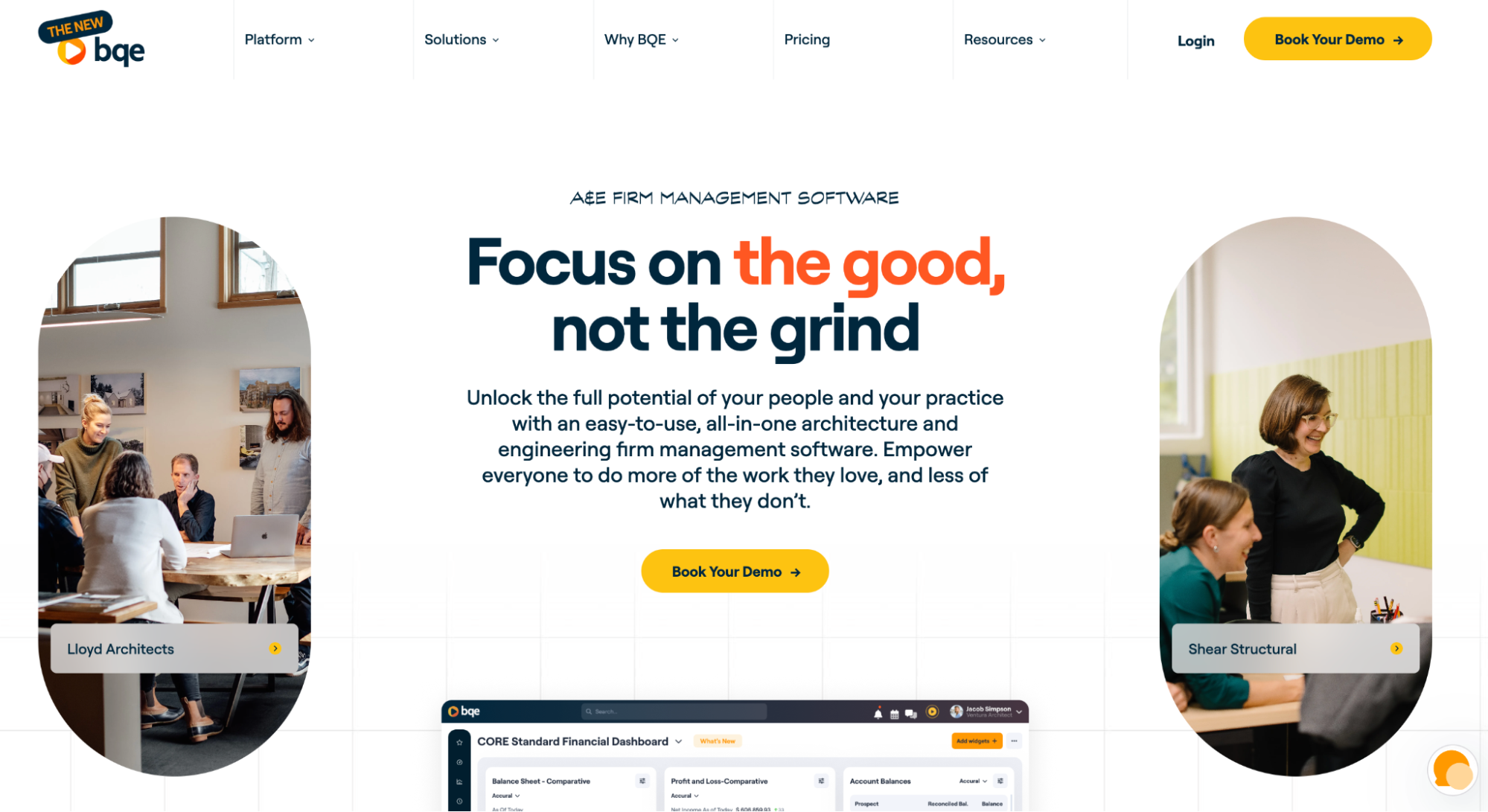
BQE CORE is a specialist engine for the A&E sector. It is one of the few platforms on the market that speaks the literal language of an architect, built to handle the unique friction of a fee-based service industry where "selling the work" and "doing the work" are often the same thing.

The seamless handoff
The platform’s standout feature is its ability to dissolve the border between the pitch and the project. When a client approves a proposal, BQE CORE doesn't just "store" that data; it converts the lead into a live project environment instantly. It automatically populates the resource plan, the billing schedule, and the budget based on your initial bid. The promises made during the business development phase (like staffing levels and delivery dates) are physically hard-wired into the studio's workflow from day one.
Architect-specific intelligence
Because it was built for this industry, the CRM layer handles the specific data points that generic tools miss. You aren't just tracking a name and a phone number, but info such as project types, site locations, and historical performance data. You can look back at previous commissions and identify exactly which project types are the most profitable for the firm.
The trade-off: specialized cost vs. flexibility
BQE CORE offers a "total solution," but that completeness comes with a specific set of hurdles:
- BQE CORE is a high-tier investment. For a firm that already has a project management workflow they love, paying for BQE’s full suite just to get the CRM features will likely feel like an expensive duplication of effort.
- To get the real value, the entire company has to live in the system – from the junior architect logging timesheets to the partner tracking the pipeline. It lacks the "plug-and-play" agility of a lighter CRM, requiring a firm-wide commitment to its rigid (though effective) structure.
BQE CORE is a solid pick for larger firms that need a heavy-duty tool to manage everything from the first lead to the final invoice. However, for studios that prioritize a lean, creative workflow, the heavy administrative guardrails might feel like they're getting in the way of the actual design.
Pricing: From $9/user/month; full suite pricing on request.
4. Pipedrive

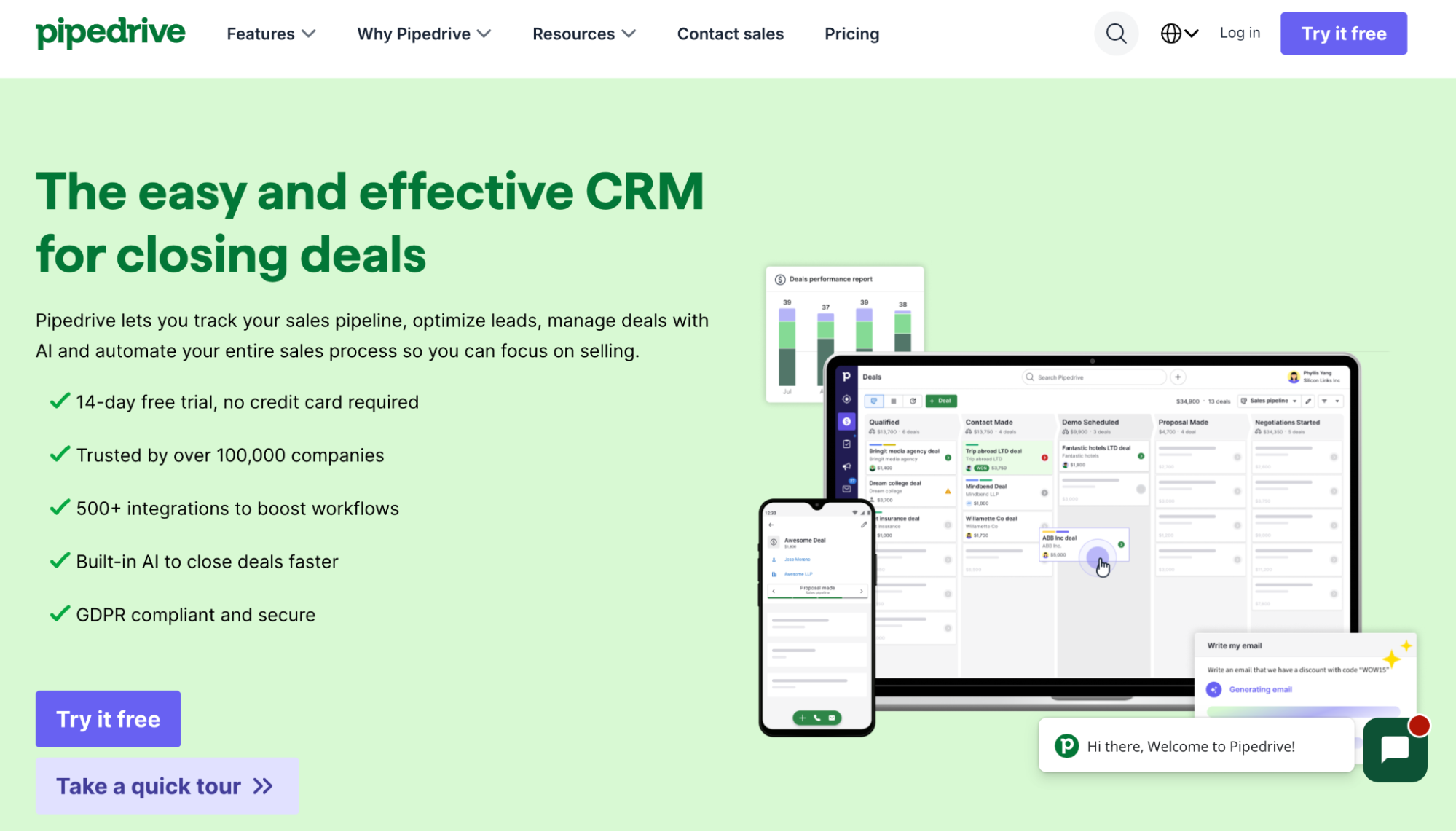
Pipedrive is built for one specific job: closing the deal. While other systems try to manage your entire studio, Pipedrive focuses purely on the "sales" side of architecture – tracking the moment a lead comes in until the contract is signed. It’s famous for its visual "drag-and-drop" boards, which make it easy to see exactly how many proposals are out for review and which ones are stalling.
Built for architects, not IT pros
The biggest draw for Pipedrive is its simplicity. In most firms, the principals are architects first and software users second. Pipedrive’s interface is so intuitive that you don't need a manual to figure it out. You can map out your "sales funnel" to match your firm's stages – like Initial Consultation, Site Visit, and Fee Proposal Sent.
Automating the chase
Pipedrive is good at handling the boring admin of business development. It can automatically schedule follow-up reminders, so you never forget to check in on an unreturned proposal. It also plays well with other tools; if you want to send a newsletter to former clients or target a specific group of developers, it hooks directly into marketing apps.
The trade-off: sales focus vs. project reality
Pipedrive is a specialized tool, which means it has very clear boundaries:
- Pipedrive is a sales tool, not a project management platform. Once the contract is signed, Pipedrive’s job is essentially over. It won't help you manage drafting hours, site notes, or RFI logs.
- Because it doesn't handle the "doing" of the work, you’ll likely need a second system for project delivery. Unless you use an integration tool to link them, you might find yourself typing the same client info into two different places.
If your business already has a solid way to manage projects (like a simple server or a separate PM tool) and just needs a better way to win more work, Pipedrive is an effective choice. But if you want a tool that follows the project from the first sketch to the final snag list, you’ll find it a bit too narrow.
Pricing: Essential from $14/user/month; Professional from $49/user/month.
5. Unanet CRM

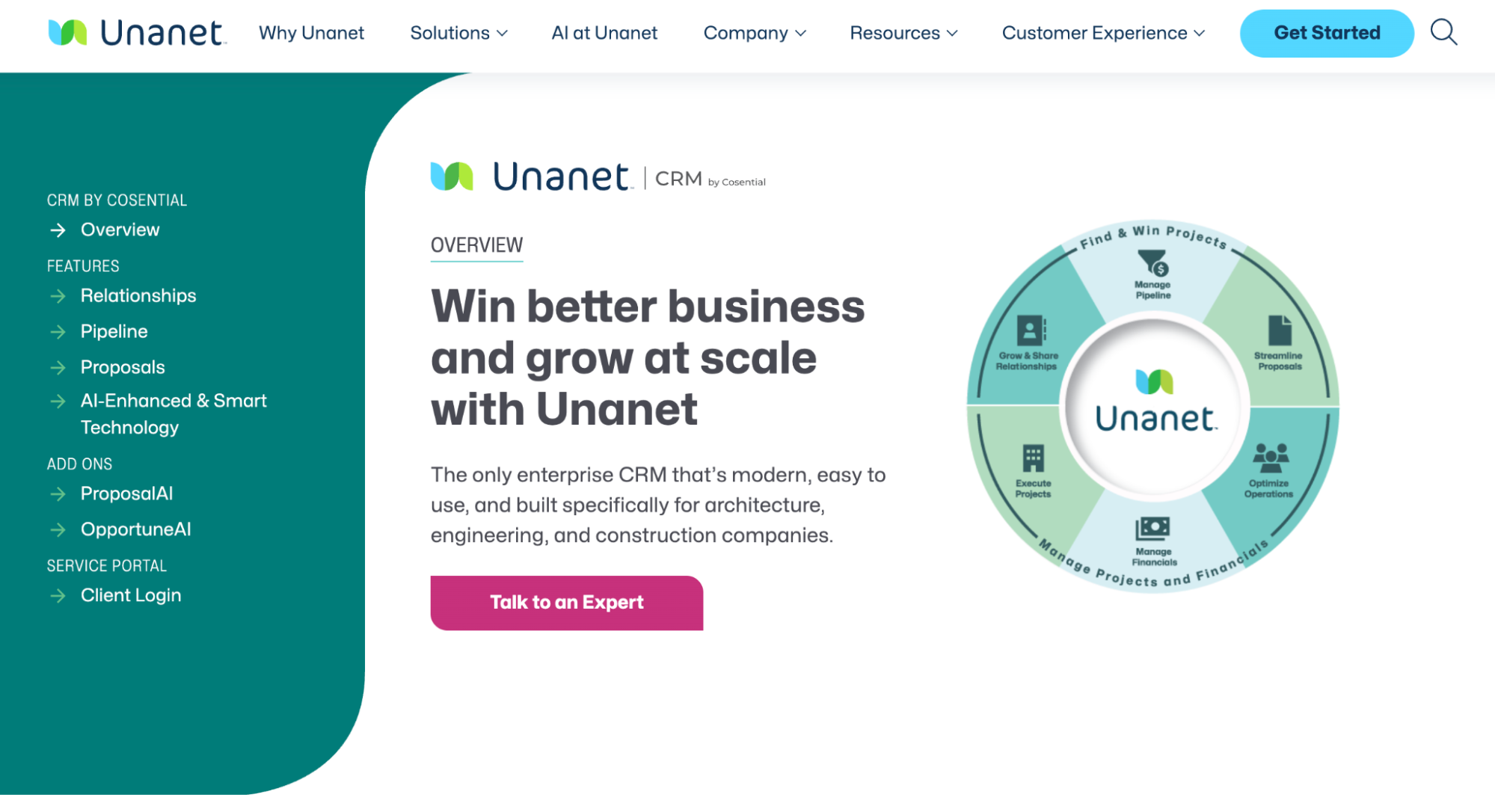
Unanet is a heavy-hitter designed specifically for the AEC (Architecture, Engineering, and Construction) industry. It doesn’t try to be a general-purpose tool; it’s built for firms that chase large-scale projects with complex bidding processes and long-term timelines. If your firm deals with joint ventures, government contracts, or multi-year developments, Unanet is built to handle that level of detail.
Smarter bidding and "Go/No-Go" logic
In a large firm, the hardest part of business growth is deciding which projects are actually worth your time. Unanet helps with the "Go/No-Go" decision by looking at your firm’s history. When you’re putting an offer together, the system automatically pulls in relevant experience from past projects. Instead of hunting through old server folders to find a similar hospital or school project you did five years ago, the data is surfaced for you.
AI-powered research
Unanet uses AI to act as a 24/7 research assistant. It pulls data from over 200 different sources to keep your client and prospect files updated. If a developer moves to a new firm or a municipality changes its planning board, the AI helps flag those updates so your contact list doesn't go stale. You get a much clearer picture of the landscape before they even pick up the phone.
The trade-off: business development vs. daily drawing
Unanet is a powerful tool for winning work, but it stops where the actual design work begins:
- Unanet is a pure CRM. It is world-class at tracking leads and managing proposals, but it does not handle project management, drafting hours, or billing. You are paying for a specialized sales engine, not a studio management tool.
- Because it’s a standalone system, you’ll have to pair it with other software to handle your accounting and project delivery. If you want one single app that does everything from sketches to invoices, you’d be better off looking at other platforms.
Large firms requiring deep pipeline insights and revenue forecasts will find Unanet delivers the data needed for high-stakes decisions. Smaller studios simply looking to track project phases might find this level of business development feels like "too much engine" for a daily commute.
Pricing: Custom pricing on request.
How to choose the best CRM for your architecture firm
- Start with your actual problem. Is it losing track of leads? Inconsistent follow-up after proposals? No visibility into which clients are approaching a renewal decision? The CRM for architects that addresses the specific gap is more valuable than the one with the longest feature list.
- Check how it handles project data. Look for a CRM system that stores project details and links communication history to specific commissions. A contact list is not enough for firms managing multi-year client relationships.
- Assess integration. Can it integrate seamlessly with your accounting software and project management tools? The best architecture crm software fits into how the firm already operates.
- Think about adoption. An intuitive interface can outperform a complex system that requires months to configure. Setup time and ease of use matter as much as capability.
- Budget realistically. Higher cost per user doesn't always mean proportionally more value. Many architecture firms find that Capsule covers the majority of their needs at a price that reflects the size of the practice.
From design intent to business impact
Winning a commission is rarely about a single pitch; it’s about the cumulative weight of every interaction you’ve had with a client. Architectural excellence gets you on the shortlist, but a disciplined process is what gets the contract signed. Firms that flourish over the long term are those that treat their network like a project: with clear phases, regular check-ins, and zero lost data.
The market offers two paths.
You can adopt a rigid, enterprise-level platform that forces your studio to work like a corporate bank, or you can choose a tool that fits into the gaps of your existing creative process. For studios where the lead designer is also the lead salesperson, the "best" tool is the one that feels like an assistant.
Capsule is built for the second path. It handles the heavy lifting of tracking leads and managing follow-ups, but stays lean enough to never interfere with your actual work. It’s a system designed for professionals who want to spend their time designing landmarks, not managing databases.