
Most small businesses don’t hit a wall because people stop caring. They hit it because the business still runs on the same habits that worked when everyone worked across every client problem.
At five people, that can look like speed. At fifteen, it becomes chaos.
The founder still approves too much. Sales still depend on one or two people. Delivery still lives in someone’s head. Clients still get a good experience, but only when the right person remembers the right thing at the right time.
That’s the awkward part of growth: the business can look successful while quietly becoming harder to run.
Growing a small business into a large one means spotting which parts of the company have outgrown their old shape. The real work sits in the less glamorous places: cleaner decisions, better handoffs, stronger managers, sharper positioning, and systems that don’t collapse when the founder takes one day off.
This guide walks through the key areas where that shift happens. Each section gives you a diagnostic question and a concrete action, so you can see what needs to change before growth turns into a very expensive mess.


1. Know EXACTLY where you're starting from
Before any growth strategy makes sense, you need an honest picture of the business as it stands. This is the crucial first step – and many businesses fail here, not because the data doesn't exist, but because nobody has looked at it clearly.
Signs you're here:
- You make decisions based on how things feel, not what the numbers show
- You couldn't tell someone your customer retention rate, average deal value, or most profitable product line
The detail that matters: Market research doesn't have to mean expensive consultants. It means understanding your existing customers and their customer preferences better than you currently do. Which customers are most profitable? Which are most loyal? What do they have in common? That information shapes every decision that follows – which new markets to enter, which products or services to develop, and which marketing strategies to invest in.
According to Harvard Business Review, businesses tend to grow more sustainably when they first strengthen their existing markets instead of rushing after new customers.
One thing to be aware of: many new businesses get this backwards, building their business model around assumptions rather than evidence. The first step is to test those assumptions with real customer data: what they actually buy, how often, and why.
Do this now: Pull your last 12 months of revenue by customer. Identify the top 20% that generates the most revenue. Write down three things those customers have in common. That's your target market for growth: not a broad category, but a specific, evidence-based description.
Ask yourself: Do I know which part of my business is most profitable, and is that where my time and marketing efforts are currently focused?
2. Fix the founder bottleneck before it fixes you
This is the most common reason growing businesses plateau. Every significant decision, sale, negotiation, or client relationship runs through one person. At a small scale, that's efficient – but at a growth scale, it's the ceiling.
Signs you're here:
- Employees regularly wait for your input before moving forward
- Clients expect to deal with you personally on matters your team could handle
The detail that matters: Rapid growth requires that the business can operate and deliver consistently when the founder isn't in every room. That means two things: documenting the processes that currently live in your head, and handing off the decisions that don't require you.
Separate decisions into those that are irreversible and high-stakes (which you should stay involved in) and those that are reversible and operational (which should be delegated with clear guidelines). Most founders are involved in far too many of the second type.
Do this now: Track every decision you make for one week. At the end, mark each one: "only I can make this" or "someone else could make this with the right information." Build a simple brief for one of the second categories and hand it to a team member this week.
Ask yourself: If I took two weeks off, which parts of the business would slow down or stop — and is that acceptable for long-term success?
3. Turn customer loyalty into a growth engine
New customers are expensive to acquire. Existing customers already trust you, already know your services, are statistically far more likely to buy again, and are way easier to upsell. Yet most businesses invest the majority of their marketing efforts in client acquisition and underinvest in client retention.
Signs you're here:
- You don't have a formal customer loyalty program or structured retention process
- You focus more on new customers than on growing revenue from existing customers
The detail that matters: Customer loyalty isn't built through discounts. It's built through consistent, personalized communication – knowing what a customer values, following up when you said you would, and making them feel like a priority.
When the business is small, people fill the gaps. As it grows, the gaps need a process.
The risk of not building that system is real: businesses that don't invest in retention spend more to attract customers than they save by keeping them.
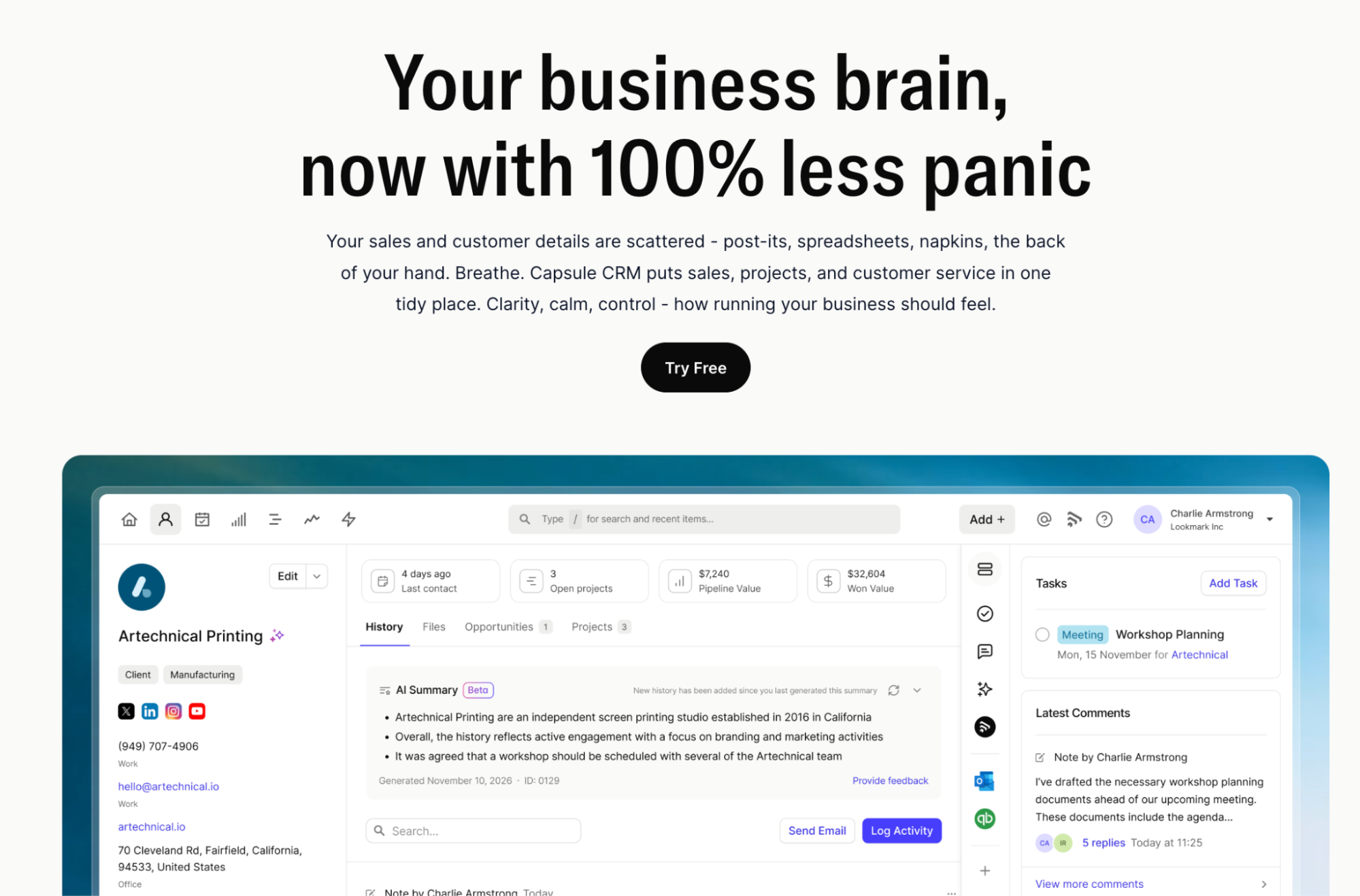
Customer relationship management software is the infrastructure that makes retention possible across a growing customer base. Capsule CRM gives every team member the full context of each customer relationship, so the quality of customer experience doesn't depend on one person's memory. As you expand your customer base, that consistency becomes a huge competitive advantage and a way to increase profits over time.

A customer loyalty program doesn't have to be complex. A structured check-in schedule, a referral incentive, or a proactive annual review with key accounts can be more effective than any acquisition campaign.
Do this now: Identify your top ten existing customers. When did you last contact each one for a reason other than a project or invoice? Schedule a no-agenda check-in with any you haven't spoken to in the past 60 days.
Ask yourself: If I stopped all new customer acquisition tomorrow, how long could the business sustain its current revenue from existing customers alone – and what does that tell me?
4. Build the processes that will carry you to the next stage
Informal systems work because everyone knows what to do. They break when the team grows, and that shared knowledge no longer exists. The business that relies on people just knowing how things work is one resignation away from a serious problem.
Signs you're here:
- Onboarding a new employee takes weeks because there's nothing written down
- Quality and consistency varies depending on who handles a piece of work
The detail that matters: Successful small businesses that scale effectively tend to document their key business processes before they feel the need to. The three that matter most:
- how you acquire customers,
- how you deliver your product or service,
- and how you handle problems when they arise.
The goal isn’t to add red tape. It’s to make it easier for strong people to join, do good work fast, and keep standards high as the business grows. A documented organization is one where new hires can attract clients and deliver value faster, because they're not spending their first three months trying to decode how the company actually works.
The industry you're in shapes how urgently this matters. In service businesses, especially, where client satisfaction depends on consistent delivery, process documentation is one of the most effective ways to reduce risk as the team grows.
Do this now: Pick the single most critical process in your business – the one that generates the most revenue or where errors cause the most damage. Write it down as a step-by-step guide, as if explaining it to someone starting their first day. Test it on your next new hire.
Ask yourself: If my three most experienced employees left next month, how much of our operational knowledge would leave with them?
5. Choose where to grow, and where not to
Business growth doesn't mean doing everything. It means doing the right things at the right time. Many businesses lose momentum (and money) by trying to expand into new markets or launch a new product line before their existing markets are fully captured.
Signs you're here:
- You're pursuing several growth opportunities at once with limited resources
- You're not sure which of your revenue streams is most scalable
The detail that matters: A growth strategy that tries to expand in all directions at once tends to achieve depth in none of them. The businesses that grow most sustainably typically follow a sequence: dominate existing markets first, expand to adjacent markets second, and explore entirely new markets only once the core is strong. This applies to other businesses that serve your target market, too – before seeking new opportunities elsewhere, look at whether there's more value to be unlocked in what you already have.
Long-term goals are easier to achieve when broken into time-bound 90-day priorities. For example, if the long-term goal is to double revenue in three years, the 90-day priority might be to increase retention by 10%. That’s a concrete, measurable step that compounds toward the larger outcome. Vague growth ambitions rarely convert to actual growth without this kind of structure.
Strategic partnerships deserve specific attention here. Partnering with other businesses that serve your target market (sharing referrals, co-marketing, or bundling services) is one of the most cost-effective ways to expand market share and reach new customers. It's also underused by most small businesses, which tend to think of growth as something the business achieves alone.
Email marketing remains one of the highest-ROI channels for reaching potential customers, particularly for businesses with an established customer base. A clean list of current customers and warm prospects can beat most paid acquisition channels at this stage. Keep in touch with useful, relevant content, and you stay visible without spending more on ads.
Do this now: List your current revenue streams and rank them by two criteria: profitability and scalability. Focus your next 90 days of growth effort on the one that scores highest on both – formally defer the others to a future review.
Ask yourself: Am I pursuing this new opportunity because the evidence supports it, or because it feels exciting compared to the harder work of optimizing what already exists?
6. Hire for the business you're building, not the one you have
Hiring practices are where many growing businesses make expensive mistakes. They hire to solve today's problems, not to build tomorrow's capacity. Also, they hire people like themselves – or, they wait too long, then hire too fast.
Signs you're here:
- Your team's skills are concentrated in delivery, with gaps in sales, operations, project management, or marketing
- You've had to let someone go because the role outgrew them faster than expected
The detail that matters: Long-term success requires hiring with a 12-18 month view, not a 30-day view. The question to ask before every hire isn't "what do we need someone to do right now?" but "what will this person need to be able to do in 18 months, and can they get there?"
The most common costly mistake is hiring people to solve problems that a better process would solve more cheaply. If the same error keeps recurring, the cause is usually a process gap, not a headcount gap. Solve the process first!
Do this now: Before your next hire, write a one-paragraph description of what success looks like for that role in 18 months. If you can't write it clearly, the role isn't well-defined enough to hire for yet.
Ask yourself: Am I about to hire someone to compensate for a process I haven't built, or to genuinely extend the business's capacity?
7. Watch the metrics that actually predict growth
Revenue growth is the metric most businesses track – and it's also the one that most reliably masks problems. A business can increase revenue while losing customers, compressing margins, and building a cost base it can't sustain. Informed decisions require looking at a small number of leading indicators, not just the top line.
Signs you're here:
- You review revenue regularly, but rarely look at customer retention rate or profit per customer
- You're busier than ever, but not noticeably more profitable
The detail that matters: The three metrics that matter most for growing businesses: customer retention rate (are you losing customers as fast as you're gaining them?), revenue per customer (is the value of each relationship growing over time?), and gross margin (is growth actually increasing profits, or just increasing costs?).
Losing customers faster than you acquire them is a growth strategy that fails. It just fails slowly, because the revenue line can look healthy while the underlying customer base is eroding. Customer retention is the metric that reveals this first.
Do this now: Calculate your customer retention rate for the past 12 months: (customers at end of period − new customers acquired) ÷ customers at start of period. If it's below 80%, prioritize retention before acquisition.
Ask yourself: Do I know whether my most profitable customers from two years ago are still customers today – and if not, why not?
Growth readiness scorecard
Rate each statement 1 (not yet), 2 (partially), or 3 (yes, clearly):
- I know which customer segment is most profitable, and my marketing strategies are focused on it.
- My key business processes are documented, and a new hire could follow them independently.
- I have a structured approach to customer loyalty and regular contact with existing customers.
- I can identify two or three time-bound growth priorities for the next 90 days.
- My team can handle normal operations when I'm not directly involved.
- I track customer retention rate and gross margin as regularly as I track revenue.
10–18: You have a solid foundation. The focus now is on systematizing what works and making informed decisions about where to invest next. To achieve growth at this stage, the priority is consistency – in customer communication, in process, and in how the team operates. Capsule CRM can help you build the customer management infrastructure that supports this stage.
6–9: There are gaps that will limit growth if left unaddressed. Pick the lowest-scoring area, create a specific plan for it, and set a time-bound deadline to address it. Focus there for the next 60 days.
Under 6: The business needs more foundation before growth will stick. That's a common challenge at this stage – the five stages of business growth framework is worth reading as a next step.
Growth gets easier when the business stops depending on heroics
A small business can survive on hustle for a while. A larger business cannot. At some point, growth needs cleaner systems, stronger customer relationships, better handoffs, and a team that can make good decisions without waiting for the founder to rescue every detail.
That’s the real shift. You’re not looking for one magic move – you’re building a business that can keep its standards while it gets bigger.
If growth already feels a little too dependent on memory, inboxes, and “ask Sarah, she knows,” Capsule CRM gives your team a cleaner way to manage customers, sales, and follow-ups.